Developer Tools Ecosystem
Browse our structured catalog of 249 modern developer tools across cloud infrastructure, AI models, productivity, and workflow automation.

Activepieces
Open-source, no-code workflow automation engine with a TypeScript plugin SDK and AI-assisted builders.
Activepieces is an open-source alternative to Zapier and n8n, built as a monorepo with a NestJS backend, a Vue-based flow builder frontend, and a Postgres/Redis persistence layer for execution state and queuing. Automations are modeled as directed flows of 'Pieces' — self-contained TypeScript modules exposing triggers and actions with typed input schemas — which are versioned, hot-reloadable, and published independently via an npm-like registry, allowing teams to build and share custom connectors without forking the core engine. Execution is handled by isolated sandboxed workers (using Node.js vm2/isolate-vm) that run flow steps with per-step retries, conditional branching, loops, and code steps for arbitrary JS/TS or Python snippets. The platform targets platform engineers, internal-tools teams, and DevOps groups who need to automate SaaS integrations, ETL glue logic, and internal approval workflows while retaining control over data residency through self-hosting (Docker Compose, Helm chart for Kubernetes). It ships with 200+ pre-built pieces (Slack, Google Workspace, GitHub, Postgres, HTTP, OpenAI, etc.), a webhook/HTTP trigger framework, and an embedded 'Activepieces Copilot' that uses LLMs to scaffold flows or generate custom piece code from natural language prompts. Its MIT-licensed core plus a source-available Enterprise Edition (SSO, RBAC, audit logs) make it attractive for regulated environments that need an auditable, extensible automation runtime rather than a black-box SaaS.
Appsmith
Open-source low-code platform for building internal tools, admin panels, and dashboards fast.
Appsmith is an open-source low-code framework purpose-built for engineering teams to assemble internal tools—CRUD apps, admin panels, support dashboards, approval workflows—without hand-rolling frontend boilerplate. The platform ships as a self-contained application combining a drag-and-drop UI builder (React-based widget library), a JavaScript-native scripting layer for transformations and business logic, and a query/datasource layer that speaks directly to Postgres, MySQL, MongoDB, Redis, Elasticsearch, REST/GraphQL APIs, Firestore, Snowflake, and dozens of SaaS connectors via plugins. Under the hood it's a Java/Spring Boot backend paired with a React/Redux frontend, packaged for deployment via Docker, Kubernetes (Helm charts), or as a managed cloud instance, giving teams full control over where application logic and data reside. Appsmith's primary use case is closing the gap between raw data infrastructure and operational tooling: engineers wire up datasources and write JS snippets to bind queries to widgets (tables, forms, charts, modals), while non-engineers can extend or tweak the resulting apps without redeploying code. Git-based version control, branching, and CI/CD deploy hooks are built in for teams that want internal tools treated as first-class, testable software artifacts rather than throwaway scripts. It targets backend/platform engineers who need to expose internal APIs and databases safely, and full-stack teams that want to avoid spinning up bespoke React apps for every internal workflow, while still allowing JS-level escape hatches for custom logic, third-party npm-style libraries, and REST/webhook-triggered automations. Because it's open-source (Apache 2.0 core) and self-hostable, Appsmith is frequently used by security-conscious orgs (fintech, healthcare, infra teams) that need internal tools running inside their own VPC alongside enterprise auth (SAML/OIDC/SCIM), audit logging, and granular RBAC—capabilities gated behind the commercial tiers layered on top of the free core.
Bardeen
Browser-based no-code automation that scrapes, connects, and triggers workflows across web apps.
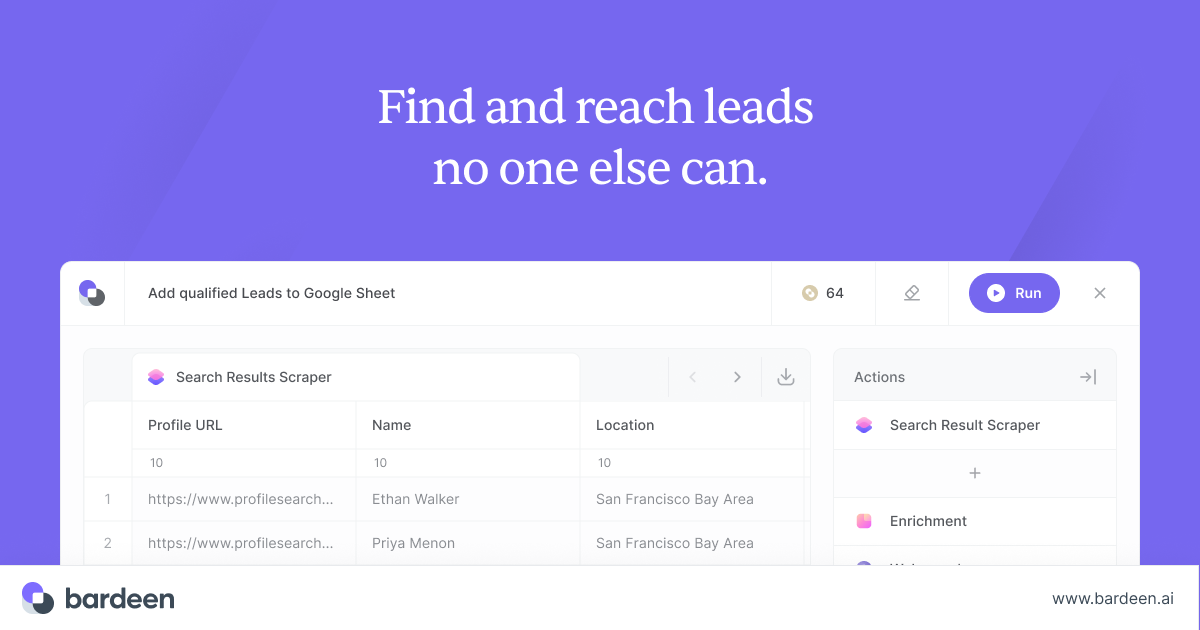
Bardeen is a browser-extension-first workflow automation engine that lets users build 'playbooks'—event-driven automations chained across web applications like LinkedIn, Salesforce, HubSpot, Google Sheets, Notion, and Slack—without writing traditional backend integration code. Its core architecture runs client-side inside the browser (Chrome, Edge, Brave), using a DOM-aware scraping engine to extract structured data from arbitrary web pages and a rules engine that maps triggers (time-based, event-based, or manual hotkey invocation) to multi-step actions across connected APIs. Unlike server-side iPaaS tools such as Zapier or Make, Bardeen executes much of its logic locally in the user's authenticated browser session, which lets it automate actions on sites without official public APIs by simulating authenticated user interactions. The platform's primary use cases center on GTM, RevOps, and recruiting workflows: enriching CRM records from LinkedIn profiles, scraping lead lists into spreadsheets, auto-logging meeting notes, and triggering Slack or email notifications based on CRM field changes. Bardeen layers an LLM-powered 'Magic Box' on top of this engine, allowing users to describe an automation in natural language and have the system generate the corresponding playbook by mapping intent to its internal action/trigger schema and available app connectors (100+ pre-built integrations plus a generic HTTP/webhook action for custom API calls). Bardeen targets a hybrid audience of non-technical operators and technically-inclined RevOps/growth engineers who need to stitch together SaaS tools quickly without standing up dedicated middleware. While it doesn't expose a formal SDK or support arbitrary custom code execution, it does support webhook triggers, custom HTTP requests with header/auth configuration, and variable interpolation across steps, making it usable as a lightweight glue layer for teams that don't want to maintain a Zapier/Make instance or write Python scripts for browser scraping tasks.
Better Stack
Unified observability platform combining log management, uptime monitoring, and incident automation on ClickHouse.
Better Stack (the merger of Better Uptime and Logtail) is an observability and incident-response platform built on a ClickHouse-backed telemetry pipeline that ingests logs, metrics, and traces at scale while keeping query latency low even across terabytes of data. The platform centers on three tightly integrated pillars: Logs (structured/unstructured log ingestion with SQL-based querying), Uptime & Synthetic Monitoring (HTTP, TCP, ping, SSL, and heartbeat checks), and Incident Management (on-call scheduling, escalation policies, and automated alerting). A core differentiator is its Terraform provider and REST API, letting teams codify monitors, alert rules, on-call rotations, and status pages as infrastructure-as-code, which effectively turns incident response workflows into automatable, version-controlled pipelines rather than manual dashboard configuration. Engineering teams use Better Stack to replace stacks that would otherwise require separately licensed tools like Datadog, PagerDuty, and Statuspage. It ships native SDKs and log shippers for Node.js, Python, Ruby, Go, Java, PHP, and Docker, plus first-class OpenTelemetry (OTLP) ingestion, Vector.dev pipeline compatibility, and Fluent Bit/Fluentd integrations for log forwarding from Kubernetes, ECS, or bare-metal fleets. Alerting integrates with Slack, Microsoft Teams, Opsgenie-style escalation chains, and webhooks, enabling automated remediation workflows (e.g., auto-creating Jira tickets, triggering runbooks, or invoking webhooks on incident state changes). The target audience is backend/SRE/platform engineering teams at startups through mid-market companies who want a single pane of glass for logs, uptime, and on-call without the cost and complexity of enterprise observability suites like Splunk or Datadog. Its SQL-native log querying (ClickHouse under the hood) appeals to engineers who prefer writing SELECT/WHERE clauses over proprietary query DSLs.
Coralogix
Coralogix: Transforming log data into actionable insights for seamless workflow automation.
Coralogix is a robust platform designed to optimize log data management and workflow automation for engineering teams. At its core, Coralogix leverages a real-time streaming architecture that processes and analyzes log data as it is ingested, enabling immediate insights and automated responses. This architecture is built on a scalable, cloud-native infrastructure that supports high-throughput data processing and storage, making it ideal for organizations with large volumes of log data. Coralogix integrates seamlessly with popular cloud providers and supports a wide range of protocols and SDKs, including RESTful APIs, OpenTelemetry, and native SDKs for languages such as Python, Java, and Node.js. The primary use cases for Coralogix include real-time log analytics, anomaly detection, and automated incident response. By providing a centralized platform for log data, Coralogix empowers DevOps and SRE teams to quickly identify and resolve issues, optimize application performance, and ensure system reliability. The platform's target audience includes software engineers, DevOps practitioners, and IT operations teams who require a comprehensive solution for managing and automating workflows based on log data insights.
Courier
Courier: Streamline your notification workflows with ease.
Courier is a versatile workflow automation engine designed to simplify the process of managing and sending notifications across multiple channels. Built on a robust microservices architecture, Courier allows developers to integrate and automate the delivery of messages via email, SMS, push notifications, and more, using a single API. This platform supports a wide range of protocols and SDKs, including RESTful APIs, Webhooks, and SDKs for popular languages like JavaScript, Python, and Java, making it accessible to a broad audience of developers. Courier's primary use cases include transactional notifications, user engagement campaigns, and alerting systems. It is particularly well-suited for engineering teams looking to consolidate their notification infrastructure and reduce the complexity of managing multiple messaging services. With features like message templates, audience segmentation, and analytics, Courier empowers developers to create personalized and effective communication strategies. The platform's target audience includes software engineers, DevOps teams, and product managers who require a reliable and scalable solution for their notification needs.